SUBJECT:
texts and articles
AUTHOR:
Sara Daher
GENRE :
Excerpts

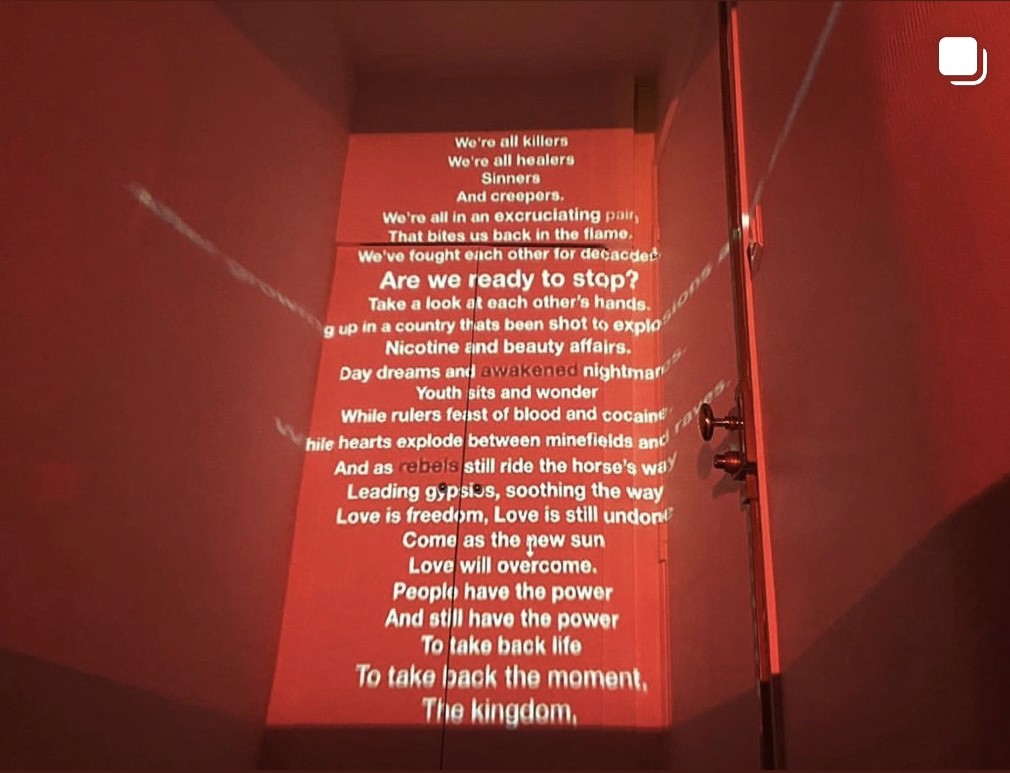
Thoughts for Acoustic Ecology:
Thoughts For An Acoustic Ecology Against A Plastic Background.
A Zen master proposes the word "yes" as the first truth, in Fragments of a Loving Discourse by Roland Barthes, "yes" stripped phonetically and literally of consonants like "hearing". This function is then probably the first truth and capacity of humans to understand spiritually and intellectually the world around them.
Nature, on the other hand, composes an immense symphony; it is the great maestro according to Schaeffer .
Speech is sound and certain noises of the city are life and nuisances at the same time [...].
The sound landscape is made up of multiple tones: Sound signals that are often perceived as an event and often refer to something else: a cause or a context.
Sound markers, moreover, are a sound that belongs to a community, like "marhaba", a way of saying "hello" that is Lebanese. This type of sound is therefore heard and understood by a community; in that sense, it resembles a sound signal while being familiar. One can say that it takes up the common expression, part of the sound landscape.
Natural sound in itself: distinct, diverse, and "immense" orchestration according to theorists like Schaeffer who considers nature as a great maestro; preserving it would be the true meaning of acoustic ecology. Tonic sound, for its part, is the one that appears in relation to another sound, like when a commuter train passes quickly next to the walls of a building.
Are the sound markers of our modernity therefore important to preserve like artifacts, since they carry within them sensory and living proof of the collective memory of our time?
Indeed, there are several modes of listening and ways to understand our soundscapes […] and especially to improve them […].
Sara Daher, Excerpt from The Visual Marker as Purification of Acoustics, 2023.

Frozen movement, a suspended moment of scientific observation in plastic representation.
The Sculpture Retracing the Trajectory of a Bullet is presented as a sculpture of time, it freezes the movement of the bullet not to annul it but to decompose it both physically and temporally; it is a representation of the trajectory between the shot and the target. Indeed, the Ready-made treadmill implies walking and stillness at the same time, and this connects with its counterpart, the looping video game, of which it is interdependent. The dynamics of this installation lie in a tension between action and inaction, the reflective and the automatic.
The study of movement is a subject that interests both the sciences and the plastic arts.
Étienne-Jules Marey was a scientist, doctor, physiologist, chronophotographer, and inventor whose work has influenced the world of arts and sciences since his contemporaries in the 19th century.
He is particularly interested in reading movement in its decomposition. Interested in the photographic experiments of Eadweard Muybridge, notably those depicting the gallop of a horse, Marey developed a series of devices such as the photographic gun, then the chronophotographic camera that allowed him to visually record the successive phases of movement. Through these fragmentation techniques, the perception of movement is changed and is no longer perceived only in its fluid continuity, but is captured and sliced in time and space, divided image by image.
Each captured moment becomes a separate visual entity. The Futurists, who sought to capture the dynamics of the body in motion, found in Marey's chronophotographs an essential source of inspiration. Marcel Duchamp's work in his painting Nude Descending a Staircase (1912) explicitly rests on this idea of frozen and fragmented movement.
Thus, the image no longer imitates reality: it synthesizes fragments of time into a new plastic composition.
Kandinsky also explores dynamic abstract forms that visually express internal tensions, akin to the tracings Marey created from the luminous trajectories of his subjects.
Kandinsky, “Dance Curves: On the Dances of Palucca
Duchamp, Nude Descending Stairs, Oil on Canvas, 146x89cm, 1912 Philadelphia Museum of Art
By crossing the boundaries between art and science, Marey freezes movement not to annul it, but to better study its inner complexity.
One of the prominent examples of this thinking is the chronophotograph of the tennis ball taken by Marey. At first glance, the image shows a series of successive positions of the same object in rapid motion. Apart from the scientific demonstration, this photograph proposes a new plastic figure, that of time while also concretizing the temporal aspect of the image. Indeed, each imprint of the ball becomes a trace, a rhythm, a visual marker suspended against the black background.
Jules Marey, chronophotograph of the tennis ball, 6.5x9cm, 1886.
The image capturing a movement can thus be considered a sculpture of time since it freezes moment x.
Thus, the immobilization of the movement of the bullet and the visualization of the Trajectory of the Bullet (page 22) is a pause in traditional straight-line time, leaving us a moment of reflection on the issues presented by the installation.
Plasticity of this sculpture is immobilized not only to decompose its movement, to know and understand it scientifically but also as a capture in time allowing us to meditate on the meaning and the responsibility that comes with the irreversible act of firing a bullet.
The moment of the shot is frozen and the sculpture echoes a global political environment that urgently calls concerned parties to action. More than aesthetic, this work recalls one of the classic functions of art, that of teaching.
Sara Daher, The Complex Interactivities of Contemporary Art, 2024.
Sciences and the Teacher's Role in Art
Charles Batteux was a contemporary of the Enlightenment, an art historian, a philosopher, and a French polymath. In his 1746 work, Les beaux arts réduits à un même principe, he explores the notion of 'feeling' when writing about art.
In "genius must not imitate nature," an excerpt from the book les Beaux-arts réduits à un même principe, Batteux addresses history and art as two instructive subjects; history as the archive of true actions and beings, and art as an eclectic imitation of history, serving to reveal what the true "could be" and thus its potential for completeness and perfection. He brings up the concept of "beautiful nature."
The author also rejects the Platonic idea that art is merely an imitation of nature and history. He argues that the artist, by inventing circumstances and altering others, must propose the possibility of "perfection" and that the artistic work should educate humanity by communicating with the mind.
The artist therefore has the right to distort reality for educational purposes.
This new definition is very interesting for its time as it falls within the Enlightenment era, the time when philosophers called on consciences to awaken, when idols began to be broken.
History recounts facts and is rooted in reality, while art sublimates history and can distort it. Art makes a selective compilation of various observations to create "prototypes," thus revealing the "beauty" of something or teaching. Charles Batteux then thinks that art is the representation of the truth that could be, which is what is called the "beautiful truth."
He makes eclectic choices that gather separate facts to create prototypes, an archetype as we did in suspending movement in Sculpture Tracing the Path of a Bullet Dassault. This work has a dual educational function; it appeals to both the affective and the cerebral.
Batteux believes that this is the example to follow for all artists and that this method is much more instructive than a rigorous historical representation. Subjectivity would thus serve progress and a rewriting of a history that has learned from itself.
He explains that the "beautiful nature" is the possibility of a truth that can be perfect, adding that nothing prevents reality or truth from being a worthy subject of a work of art.
Ultimately, the author continues his definition and asserts that a work of art has the right to use a previously interpreted or artistically distorted historical fact and to continue to adjust it as desired, for aesthetic or educational purposes. The "Beautiful truth" thus becomes an art that, through aesthetics, changes the form of a historical fact for the purpose of educating and teaching.
Approaching this idea of the "beautiful truth," Hervé Fischer, a writer, philosopher, artist, sociologist, theorizes "sociological art" as the questioning of the relationship between art and society and addresses the issue of the artist's place in relation to socio-political questions.
His work is non-institutional; in the 1970s he created it on the streets, in the countryside, and today he works on social media and is interested in digital practices and the new uses that emerge from them.
The ethical concern in his works is greater than the aesthetic concern; for him, ethical science is the most important, and the artist must have a role beyond aesthetics, which is to anchor his work in its time and address urgent issues, whether humanistic and/or social.
Hervé Fischer, Hervefischer.art
Nada Sehnaoui, Haven't 15 Years Of Hiding In The Toilettes Been Enough? 600 toilet chairs in downtown Beirut, 2008, Lebanon
In a kind of immediate immersion without asking the public for direct interaction, Nada Sehnaoui, in Haven't 15 Years Of Hiding In The Toilettes Been Enough?, takes over public space in Beirut and freezes a moment of history in the capital's downtown. Her work consists of the repetitive placement of a ready-made: toilet chairs in this strategic location in Beirut: Martyrs' Square.
Nada Sehnaoui revisits the traumas of war, with the aim of rewriting a collective memory of the Lebanese civil war.
Indeed, Lebanon's history has not been officially documented since 1944, the year of its independence declaration; all the wars the country has experienced since have occurred without communities agreeing on a common writing of the facts.
Sehnaoui places 600 toilet seats in a grid near Martyrs' Square; this installation evokes the memory of the refuge that Lebanese people found in restrooms to escape bombings and gunfire during the civil war.
Fifteen years of civil war is symbolically frozen in the centre of Beirut to create a space for collective reflection and recollection, confronting us collectively. The memory evoked is both intimate and collective, transversal; the installation touches on collective trauma through the detail of sometimes having to hide in toilets. The object of the WC becomes like an artifact and its symbol like an archive of this war.
What the artist invites society to do is necessary and vital for a population that wants to survive and evolve together. Indeed, the revisiting of these shared memories can be seen as a step toward national reconciliation.
Through a trivial ready-made, the toilet chairs, Nada Sehnaoui disavows aesthetics; her ethical duty is greater. Like Duchamp in R. Mutt, she uses a WC furniture piece, but her denunciation is at least doubled: that of war and a critique of the art market and its inaction, in the same vein as Duchamp's work, creating a triple denunciation through the association of these two ideas.
The chairs evoke staticity, a hint of entrapment in the past as the memory of the Lebanese civil war is not addressed by Lebanese society, which the artist still considers inactive. Indeed, the arrangement of the chairs reveals this paralysis as their situation is frozen and almost stagnant.
In this sense, one could consider that Nada Sehnaoui's work, through the effect of repetition, calls for the opening of collective memory, as proposed by Boissier in Art as an Interface of Knowledge and Memory.
The repetition and the suspension of collective time can be perceived as a reflection on the slowness of the reconciliation process and on the psychological suspension after the conflict.
This rewriting of war memory aims to provide a new opportunity for recollection and narration of History.
The installation Take A Stand makes the Ready Made treadmill, by its moving yet non-displacing nature, the sculpture Trajectory of a Rifle Bullet, the video coded as “+1” and the looping video game converge in their staticity that renders time suspended, an interface conducive to interactivity and public reflection.
The repetition in the plastic and referential body of this installation distorts history, and with it, time, no longer considering them as linear or precise.
Sara Daher, The Complex Interactivities of Contemporary Art, 2024.
Danto, the closing of the history of art
“Ideas and forms merge and shift the doctrine of Plato and with it those of the past, opening doors to different possibilities of interpretation and artistic definitions. Danto then raises the question: if the gap between art and reality were to be filled, if the two merged, how then would we define a work of art and an ordinary object? Through this new question, Danto announces the theorization of a new movement, that of modern art where definitions are still to be discussed.
Some artifacts retain their status while others become works of art, dependent on the interest that the artist may give them. It is therefore no longer a duality between representation and reality but a “perfect resemblance” between the work of art and the ordinary object, and what makes a work of art would be a question beyond form and aesthetics. Danto refutes Plato by stating “could not have distinguished them,” restoring merit to the artist since he is no longer “at the lowest rank of reality that can be imagined.” The distinction between art and object being no longer visual, we can say that ancient mimeticism becomes a perfect perceptible resemblance. ”
Danto and the Closure of the History of Art, Sara Daher
The sequel is in the process of being deposited.

The vanished artist, a quest for the autonomy of the work
L'artiste disparu, une quête de l'autonomie de l'œuvre
Après Dieu c’est l’auteur qui est mort. Cet écrit est rédigé dans le 4ème semestre de 1968, cette œuvre se situe alors dans l'après mai 68 et dans son esprit anti institutionnel. Pour Barthes l'auteur vient avec l'empirisme anglais et prend sa forme finale avec le capitalisme.
Libéré des contraintes et des marques de l’auteur, le texte pour Roland Barthes dans La Mort de l'auteur devient une collaboration entre plusieurs pôles : principalement avec le lecteur.
Barthes décrit le texte comme un tissu de citations, tel un ensemble de signification qui se lie sur la toile du texte.
En brouillant les limites entre auteur et lecteur, il critique les mystifications des auteurs qu'il trouve contraignantes et inutiles a l'évolution du texte. Il encourage à une participation générale à la littérature et dépossède l’auteur de son autorité sur le sens du texte. L’interprétation de l’œuvre littéraire est ainsi vouée à ses lecteurs, leurs expériences et leurs analyses. C'est dans ce phénomène de la pluralité des sens que nous pouvons trouver une richesse et une universalité.
Par La mort de l’auteur, Barthes libère l’auteur de son rôle de responsable des codes rigoureux de l'esthétique et de lecture authentique du texte, laissant au lecteur la liberté de donner et ajouter le sens qu’il veut à celui-ci, cela pouvant ainsi révéler des dimensions nouvelles au texte. Nous sommes alors dans une pluralité des voix et non plus dans la singularité de la voix de l’auteur.
La mort de l'auteur commence avec le surréalisme d’après Barthes: le cadavre exquis ou l'écriture autonome ou l'on a fait livrer l'écriture à son propre inconscient et à la collectivité.
Le texte dans ce cas devient le message de l’inconscient ou du collectif. Ce n'est plus l'auteur qui est à l'œuvre mais le langage, l'auteur en est uniquement le récepteur, celui qui véhicule le message des mots, des idées de l'époque et du langage. On supprime donc pour Barthes l'auteur au service de l'écriture. La narration serait un acte automatique qui se fait comme par un scripteur qui repère et relaie la parole du langage. Le langage est donc celui qui écrit et non pas l'auteur. Il s’agit donc uniquement de savoir repérer le sens du langage, voici le seul savoir demande. Le scripteur serait “sans passion, sans amour, sans goût”, entièrement objectif.
Barthes défend l’abolition du sens puisque tous les sens sont possibles et qu'il confie la nouvelle possibilités de les donner. Ce dernier enregistre et relaie.
Nous assistons à la naissance du lecteur par la mort de l'auteur et la disparition du sens du texte. Ce dernier dépend du lecteur et peut donc refléter les diversités, les divergences, convergences et les caractéristiques diverses du public. Le texte dont l'Auteur est Mort devient donc révélateur du caractère et des caractéristiques du lecteur et ouvre le texte vers le futur
Gilles Deleuze lui considère dans sa théorisation du Corps Sans Organes CoS, d’Antonin Artaud qu'écrire n’a rien avoir avec signer mais cartographier même des contrées à venir”
Sara Daher, Les interactivites complexes de l’art contemporain, 2024.
https://acrobat.adobe.com/id/urn:aaid:sc:EU:83a6f64e-042c-4620-ba26-852fbdfeea21